
002. Popsicle Mansions
G
rade 6 felt like one step closer to earning the privilege of leaving school grounds for lunch. From behind the schoolyard fences, we would watch the seventh graders of Samuel Hearne, eating candy and pizza slices from the local convenience stores. It was inspiration for a 12-year old.
Whatever we observed from the older kids across the fence, we practiced. As seniors of the school, we no longer experienced the playground the same. Many of us had responsibilities like band, choir, book clubs and more. We were the new leaders and investing in our future selves.
But the prestige I felt being in Grade 6 came from the pride and luxury I had of being a student of Mr. Langevine. The class that every student wanted to be in.
Mr. Langevine was a tall, muscular man with a deep voice that echoed the hallways of Oakridge Jr Public School. He was a newly transferred teacher from Samuel Hearne - the middle school that felt like one step closer to adulthood with an outdoor basketball court.
I personally heard about Mr. Langevine from my older sister, who went to Hearne. Alongside him and another teacher Mr. Parker – they were impressionable and made a massive impact on the students around them. She would ramble on about the teacher relationship bonds and how different it was in middle school. Very soon later, a classroom of 30 odd students in Oakridge was going to get the fresh, rich experience of a Hearne teacher.
We got new teachers all the time, we hardly cared...or at least I didn't. But, what made Mr. Langevine's entrance significant was his Blackness. He was a Black male teacher, strutting the halls with the same spirit we see from our fathers, uncles and brothers. But he was in a school setting, holding a position of power as an Educator. To my adolescent brain, Mr. Langevine was a unicorn. Before his time, the other unicorn at school was Ms. Dixon – a sharp, polished dark-skinned woman with silk pressed perm that wore a dark rouge pantsuit with gold buckles. Her bone structure was defined like Grace Jones
 Grace Beverly Jones
A Jamaican model, singer, songwriter, record producer, and actress. Jones influenced the cross-dressing movement of the 1980s and was known for her bold style and features. Many recognize her from her role in The James Bond movie, A View to Kill (1985).
, and with one of her special greetings, she would cheer up your entire day.
I remember Ms. Dixon would carry a gold bell with a wooden handle in her hand and ring it with emphasis and strength at the 15 minute mark for recess. She wasn't a teacher, she was a Principle. But I wished I could sit in her class and have her boss-like energy transfer onto me.
Representation matters.
On the first day of Grade 6, my family had already prayed that I would be in Mr. Langevine's class. When we received the letter with my room number and 'T. Langevine' written in times new roman font below, we rejoiced. The 3 min walk to school was filled with a pep in my step but also butterflies. What on earth will my new Black teacher be like?
F
or a pre-teen, Mr. Langevine was the epitome of cool. Standing over 6-foot tall with his blingy LA Laker's watch to match his Kobe Bryant jersey
LA Laker's Jersey
Unconfirmed if it was specifically a Kobe Bryant jersey or Shaquille O'neal.
. You can tell he wasn't the average teacher that wore plaid shirts and khakis with velcro sandals. His confidence exuded across a room filled with students. It's also what allowed him to withstand students that derisively came for his shiny bald head.
He had a witty come back to all our remarks, which interestingly taught us how to refute when we were picked on. At the end of the school year, we were also telling our peers,
"Go wash your mouth."
His aplomb demeanour gave off a synergetic big brother presence, especially amongst Black students.
On my way home from school on the third day of 6th grade, my best friends at the time – Abel and Hany were talking about our classes and teachers.
"Yoooo we got the best teacher, a Black guy! We're gonna pass everything."
Abel and I had Mr.Langevine as a teacher, Hany didn't. But, he was determined to never miss out on the Black teacher experience.
For the record, Mr. Langevine didn't pass us because we were Black. He pushed everyone in the class to be their absolute best and to explore their full potential. Not in a standard way that included – encouraging report card comments or stickers on homework. He spoke to us like we were all Olympians preparing for a big day. It was his auspicious energy that fuelled a passion within us. You couldn't find that in many TDSB
TDSB
Toronto District School Board is the English-language public-secular school board for Toronto, Ontario, Canada.
teachers.
The mornings usually started with a hand clap that followed with a hearty “Good morning everyone.”
Throughout our work periods, he would pace around our desks, nod his head in observation, and sometimes hang his lower lip out in amusement or intrigue. He had so much charisma that was reminiscent of my Caribbean household.
There were times when we saw a different side to Mr.Langevine. Like when we completely disrespected a supply teacher. He wouldn't greet the classroom the same. It was much like your parents telling you they were disappointed you - one of the most horrific things to hear as a comprehending child. His disappointment cut deep that we never wanted to see our hero, our mentor, our teacher, look at us like that again. So, for the most part, our class was incredibly well behaved.
Before Mr. Langevine, many of my teachers were copacetic. There wasn't much of a bond between them and the students. And it remained the same after. Teachers that followed could not live up to his standards. He did not set the bar, he was the bar.

Class of 2003/2004, Oakridge Jr. Public School
In
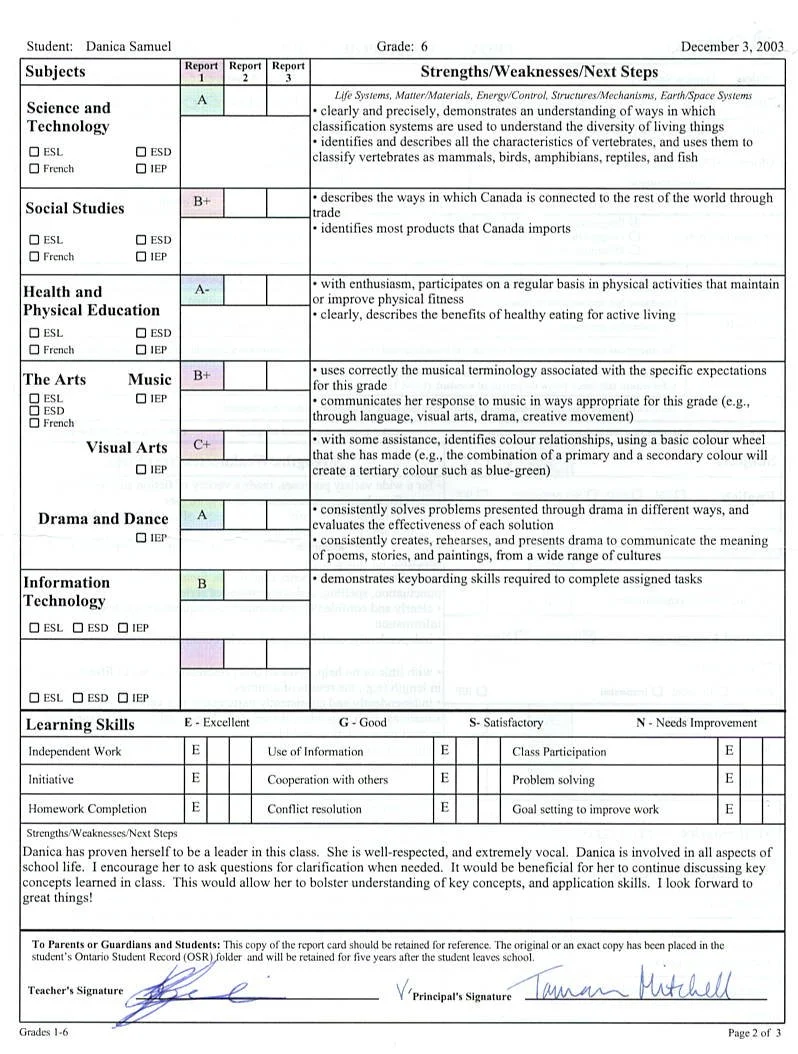
October of 2003, Mr. Langevine arranged our class from the highest grade point average to the lowest. It was serious business. High-graders sat near the window, and the others trickled down towards the entrance of the classroom. This was pretty intense for our age, I must admit, but it motivated all of us.
As an athlete, this bold approach excited me. It created a sense of competition amongst my peers, but most importantly, within me. Starting out at the third group table, I was determined to climb my way to the top and stay there. I fluctuated here and there, but for the most part, I remained at table one, proud of my high-grades.
All of us worked extremely hard to get a seat at the front window table. This process was synonymous to precisely how we navigate life to this very day. I knew that all my hard work went towards my position in the classroom. So, I made every single effort count. Every quiz, assignment and test I was prepped. I knew if I failed to prepare, I should prepare to fail.
In Mr. Langevine's class, we learned parts of our subjects in grades 8 and 9 standards. As a 6th grader, this gave us a different level of pride. The students across the field with basketball hoops and poutine lunches started to look more like a reality for us. We were ahead of the game. Our chest was high because our knowledge was increased without limitation of our age or size.
Mr. Langevine didn't believe in restrictions such as too hard, can't, or impossible. When subjects became difficult, his words of encouragement were full of energy that you knew you had to push through. He was determined to make sure we never gave up and used his Caribbean tough-love so that it would never happen.
When it came to Math, he would use the chalkboard
Chalk Board vs. White Board
A lot of chalk boards in TDSB were being replaced with white boards and markers during this period of time. It's very likely that Room 211 had a white board instead.
to bring all elements to life. Can I say that it takes a special type of person in the entire galaxy to make me enjoy math to this very day. This is why I mentioned that he would push us to our full potential. Even Mr. Langevine came very close with using his animated circles, bald smiley faces and unique characterization of math elements. But it was the probability questions that kept dropping my position in the classroom to the third and fourth tables. Here's an example of why:
If johnny buys 3 bags of apples with 24 apples in each bag. The total cost of the 3 bags is $12.24. He sells the apples for $0.75 each. How much money does he gain per apple?
My answer would be something along the lines of Johnny needs to sell the apples in bulk.
Yeah, I wasn't good. I told you.
But with Mr. Langevine's hearty laughs, we got to the correct answers together.
That word - together, is what we all witnessed. The trouble makers from impoverished neighbourhoods
Teesdale and Cataraqui
In Toronto's early 2000's, there were neighborhoods with community housing complexes that had high crime rates. Cataraqui (aka Block 13) was once known as a crime-ridden housing project located in the South-West end of Scarborough. Teesdale Place consisted of Block 13's rival gang members. Oakridge Jr Public School and Samuel Hearne Middle School were situated between the two neighborhoods. See more: Real Toronto Documentary (2005).
that didn't have positive guidance felt like someone was in their corner. He dispelled the notion of not doing homework to appear rebellious or cool. Because cool was a lot more inclusive than we thought. I watched students cry when Mr. Langevine pushed them to conquer their fears. After class and during class, we were not alone in whatever we were struggling with.
Sitting at the front of the class near the window with a view that anchored above the school grounds was motivation. We could gaze over Oakrdige's field and observe the middle school students - the other side and our future education. When we looked down at the desk in front of us, we saw the hard work we had to do to get to that other side. It was foreshadowing at its finest.
Moving into one of those seats was something a few students believed they were incapable of, and sometimes others thought their peers were inadequate. But those thoughts of judgement were quickly silenced when the trouble makers and struggling students all got their time to sit at the front table. It wasn't Mr. Langevine trying to be fair either. The way he taught, encouraged students to transfer from a place of "it's too hard" to "I can do this." And with that, everyone earned their seat.
The smiles on the faces of my peers that sat next to the window at the front of the classroom are something I will never forget. It was a grin that radiated from being capable.
Students with other teachers begged to switch classes just so they can be with Mr. Langevine. Remember Hany? Half-way through the school year, he and other kids he influenced in his class, willfully stayed back after school to learn and spend time with Mr. Langevine. If it was possible to skip class in elementary school, a lot of kids would skip and join room 211. Because, Room 211 made strong memories. No one in Grade 6 wanted to miss out.
I remember a lot of memories with Mr. Langevine - our banter about basketball teams, his Guyanese heritage, and shared traditions passed down within Black households.
I want to bring attention to something here. Mr. Langevine spoke to me like a human being with respect. Not like a subordinate. There were boundaries, of course, but the connection was never dismissed because of my age. He never failed to acknowledge when I or any other student would teach him something new. Additionally, he would highlight his new learnings in class, actively showing us that adults can be corrected, too.


Between Mr. Langevine and me, our most memorable moment was when my team – Indiana Pacers had lost to the Lakers, 97 – 94. A three-point game. A particular sort of heartbreak, especially when you have to face your opposing friends the next day. Abel and Hany were teasing me, and Mr. Langevine was ready to see my reaction. I held it together, I was quiet. When he came up to my desk, with his hanging lip, ready for the banter, I looked up from my notepad and said, "every dog has its day." There was no comeback from that. It was a precocious 6th grader mic drop.
We (the Indiana Pacers) never beat Lakers that season but, you get where I was coming from with the faith. And, Mr. Langevine definitely laughed with my parents about it in a parent-teacher interview.
Everyone in Room 211's class of 2003/2004 will never forget our final project before graduation. Mr. Langevine created a beastly assignment that required us to design our own miniature model houses out of popsicle sticks and toothpicks. We were responsible for implementing our knowledge of math, English, geography, and science to develop a dream house for consumers. In the end, we presented our final homes in an open house in front of TDSB staff and parents.
At 12 years old, I remember spending countless hours designing floor plans to scale and using mathematic formulas to measure, cut, and glue houses. We had teachers from other subjects read our home descriptions to make sure we were developing persuasive content. The work ethic that went behind that project is definitely one I will lecture my children on whenever they complain about school.
The housing assignment brought out everyone's confidence. It was the talk of the school. Teachers were all interested in seeing our final products, and in retrospect, I think this was a way for Mr. Langevine to make a lasting impression in his new work environment.
After weeks of sacrificing my lunchtime to work on the assignment, no one could tell me that the house I built out of toothpicks and popsicle sticks wasn't a mansion. From outside the windows of room 211, I would hear the lunch bell ring, and laughter of students skipping rope and running around. But I was burning the midnight oil… or lunchtime oil, I should say.
That project was so impactful because it wasn't just about creating a fancy house. It was Mr. Langevine's way of inspiring us with the importance of building a foundation. As we carefully curated a meaningful environment for our homes, it was a mirror into the future lifestyles we wanted for ourselves. If we could build that at 12-years old, we could create anything...if we put our minds to it. This was a testimony wrapped in a school assignment. We were learning the importance of investing in ourselves, with popsicle sticks and glue. Every measurement, written description and furnished material was a layer into what transformed our houses into mansions.
On open house night, I got dressed up in my church clothes for my presentation. This was proof that I was about business. I practiced my pitch in the mirror leading up to the big day. I was prepared to exceed, just like I had done all year long, swinging my feet at the chair of table one, near the windows.
When I saw my parents walk through the library doors, the butterflies fluttered all in my stomach. They went around the room and admired the other students and left the best for last. In typical Samuel family tradition, they spiced up the experience by role-playing as my clients. So, I gave them the pitch of a lifetime.
Later, with finger food and drinks in their hand, I watched them speak in great length with Mr.Langevine. (Okay, I'm not sure if it's just me, but seeing my parents talk to Black teachers throughout my school years always made me feel proud, protected and confident. I'm not sure what that feeling is, but those bonding moments were unforgettable to me).
The next day, as we celebrated our incredible projects over pizza lunch, everyone in our class was super excited to accomplish such a massive project. I think this was the first time we couldn't wait to receive a mark back from a teacher.
In a tremendous form, Mr. Langevine showed us that when you pour your heart into everything you do, you can watch every aspect of your life flourish. We saw the fruits of our labour blossom through constructed popsicle sticks on display in the hallways of our Elementary school.
The impact of Mr. Langevine's mentorship and teachings has been everlasting. He taught us life lessons through subjects that we considered mundane. To this very day, there are life principles from Grade 6 that are applicable in my everyday hustle. My desire to learn beyond curriculums will always be apart of my DNA because I am determined to swing my feet at the table of life that overlooks all my manifestations.
Those that teach us skills and trades are important, but the teachers that beautifully orchestrate the fundamentals of life are the ones that last in our souls forever.
Whenever I'm reminiscing about Mr.Langevine with my childhood classmates, they all have a specific moment with him that inculcated something inspiring. Whenever I tell someone new about Mr. Langevine, they all want to meet him. I know that wherever and whichever community he steps into, everyone he teaches will come out, turning their popsicle sticks into mansions.
Mr. Langevine wrote a letter to the graduating class of 2003/2004. Read or listen to the letter below.
