
005. Eskista, Tibs and Buna: Memories in Toronto’s Addis Abeba
W
hen I stare at the cultured clothes in my wardrobe, I reminisce of how I fell in love with Little Ethiopia. Kemis
 Habesha Kemis
Habesha kemis is a traditional attire of Habesha women. It is made of cotton fabric, and typically comes in white or beige shades.
and scarves gifted to me, spark memoirs of Toronto's Habesha
Habesha People
Habesha is a term that refers to people of Ethiopian and Eritrean heritage.
community.
Although the label of Little Ethiopia isn't ordained by the City of Toronto (BIA), many citizens embrace the essence of Addis Abeba - nestled between the east of Danforth; starting at Greenwood and stretching to Woodbine, and Main with a sprinkle near Victoria Park.
As a child, my grandmother lived near Greenwood and Danforth, in the heart of Toronto's Addis Abeba. I would exit Greenwood station and hear the slow beat of drums puncturing restaurant speakers. The sounds were mixed with strings, flutes and tambourines. Walking by the patios, I saw beer glasses clanking, and arms crossing over one another at the dinner table to eat the lentils, cabbage and sliced meat on Injera
Injera
A sour fermented flatbread with a slightly spongy texture. It is traditionally made out of teff flour in Habesha cuisine.
.
I noticed they kissed from cheek to cheek. Mixed in with their laughter, I heard specific expressions when they reacted to what looked like life stories being shared.
At a young age, the
Amharic
Amharic
Amharic is an Afro-Asiatic language of the Southwest Semitic group and is related to Geʿez, or Ethiopic, the liturgical language of the Ethiopian Orthodox church; it also has affinities with Tigré, Tigrinya, and the South Arabic dialects. SOURCE: Britannica
written on the convenience stores and restaurant fronts had me confused. It reminded me of Egyptian and Arabic, with calligraphy that felt ancient and historical. The written language told me a story of an ancient civilization, one that I saw in movies. My ignorance fueled with my curiosity led me to a lifetime of love and appreciation for Ethiopia.
I remember describing Ethiopian people to my household at a young age. I had a considerable admiration for
Oromo
Oromo
Oromo people are a Cushitic ethnic group native to East Africa who speak the Oromo language as their mother tongue. They are apart of the largest ethnic group in Ethiopia.
women. Up until that point, honey brown eyes, dark brown skin and silky hair were a combination I believed was foreign unless you were of mixed ethnicity. I was obsessed with the full-flowing afros of Ethiopian women on the Danforth. I told my mother about some of the "cone-like hairstyles" I saw that sat like crowns on their scalps. The light beige fabrics they wore across their bodies had bright colours at the hems and looked like soft, breathable material. I mentioned how their distinct features, of longer foreheads, aquiline noses, sharp heart faces and flawless brown complexions, had me staring in fascination.
Without knowing the names or appropriate references of their culture, I learned really fast that the people near Greenwood and Danforth were royalty.
From elementary to middle school, my Habesha friends adopted me into their culture. After their Amharic speaking classes, they would teach me words and phrases throughout the week. I remember knowing that Zim Beli meant quiet! And we used this whenever we were talking about someone who came across the corner.
By
grade 9, I had dipped my hand in many Injera dishes and stuffed my stomach with succulent Tibs
Tibs
Tibs is blend of stir fry and stew - it's a meaty, spicy dish served with bread, rice or, more injera.
from several Ethiopian restaurants across the Danforth. The smell of Buna brewing and coffee beans roasting became embedded in my senses. The incense of herbs and Kerbe (Myrrh)
Myrrh
The Kerbe Myrrh is a gum-resin extracted from tree species. Myrrh resin has been used for perfume, incense and medicine.
solidified I was entering Ethiopian spaces. My initiation to coffee was in the home of my childhood best friend, Maedot. She lived in the apartments of Teesdale Place; a neighbourhood populated with many Ethiopians at that time. We sat with our legs folded on plush cushions with her mother, who had a traditional Kemis covering her braids. As she poured the pure coffee into our teacups, I held the small handle with my index, while sticking out my pinky finger. The moment reminded me of my childhood tea parties. I sipped my first taste of the coffee, with my upper lip quivering at its purity.
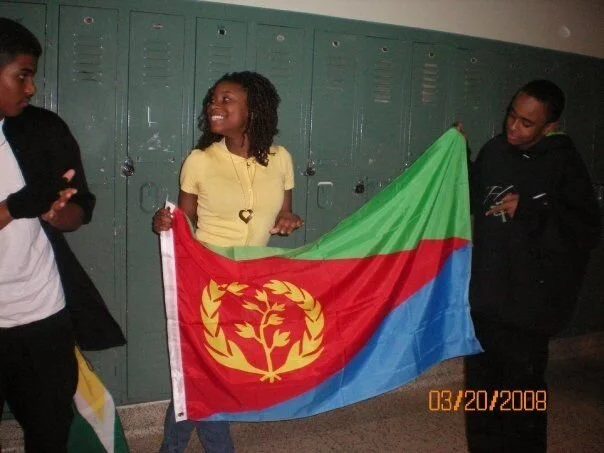
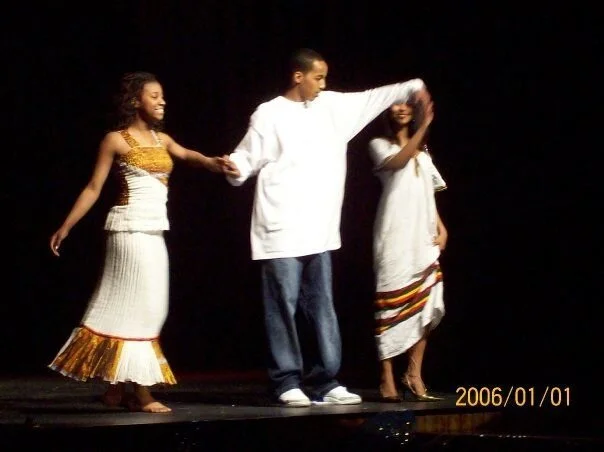
Multicultural day at SATEC @ W.A Porter.
I wasn't allowed to have coffee when I was younger. My parents felt it was too strong for me as an adolescent. There were many infomercials and news coverage about the effects of caffeine being equivalent to cigarettes in the late 90s and 2000s. But I never told my parents until much later. When I did tell them, I explained the tradition and called it holy and sacred coffee. I was positive that Buna could never have the same results as Tim Hortons. It was coffee that was absolute and healthy.
More and more, I became the adopted child to my Habesha community on the Danforth. After visiting my Grandma or finishing school, I would hop on the Bloor-Danforth train to Woodbine and get my hair done by Elsabeth (Elsa) at Zoma Beauty Hair Salon (my hairdresser to this very day). Her bright orange walls were filled with tribal sculptures, traditional hair picks, and black and white hair portraits of tribal women from Oromo, Tigrinya, Donga, Amhara, Hamer, Mursi and Dassanech people.
I remember seeing the hot combs steaming in ovens while Habesha aunties sat under the hairdryers with curlers. As Elsabeth styled and braided her clients, I sat in admiration and jealousy – wishing my hair could be like theirs. Every time I complained, she reminded me of how beautiful I was.
Elsabeth made it her duty to make sure I loved and appreciated my hair even if I wasn't Habesha.
At Zoma's I learned the most about Ethiopian culture and tradition. As Elsa massaged my scalp over the basin filled with shampoo, she would tell me about various hair techniques and self-care traditions of her people. And of course, there were an odd few times I was invited for Buna in the staff room.

I enjoyed sitting in the hair salon chair watching TV. I would hold my ears as the sizzling hot comb ran through my edges and through my nappy hair. On TV, she played music videos of Teddy Afro, Gigi, Behailu Bayou and Habesha Christian artists.
The women in the salon would clap their hands and translate the lyrics for me. My cherishable moments were when they reminisced about first hearing their favourite songs on the radio.
One day, I overheard a woman in the salon talking about a millennium.
She was styling her hair in Shuruba
Shuruba Hairstyle
The Shuruba hairstyle consists of cornrows tightly braided to the head, with hair spread out at the shoulders. It is often styled with hair extensions, beads and jewellery. Shuruba was popular among emperors and empresses - worn as a symbol of pride and patriotism.
– the same traditional crown-like hairstyle I shared with my family. The cornrows mounted on her head with smaller micro cornrows in between covering the front half of her scalp. The bottom half of her head flowed with a luscious wavy afro.
When I asked about the millennium, Elsa grabbed my shoulders, excited to explain.
The women in Zoma's hair salon described the festival as a massive gathering for Habesha's all over the city. It was a time to celebrate their New Year in accordance with the Orthodox calendar. The event took place at Christie pits (Koreatown, Toronto). As they described festivities to me and emphasized my potential Habesha boyfriends, it sounded like an event I couldn't miss out on.
Within the next few days leading up to the Millennium, I told my Habesha friends I wanted to go. We planned to meet up for Injera and then roam the festival celebrating.
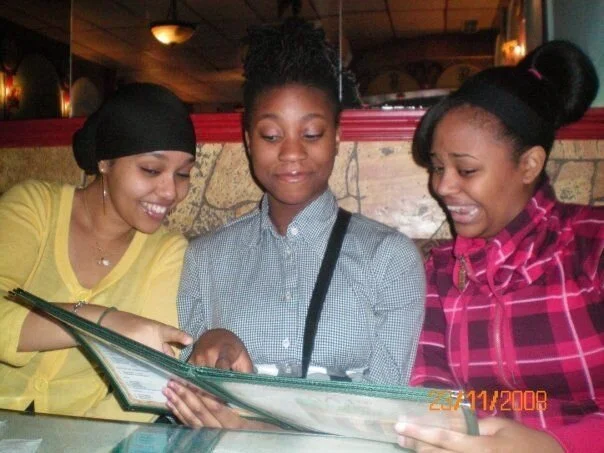
My high school friends and I ordering food at Lalibela’s before the Millennium celebration at Christie pits. Ahlam (left), myself, and Demaris (right).
We met up at Lalibela's restaurant, which was one station away from Christie Pits Park. For a late lunch, we feasted on: Dero Wat, Kitfo, Shero with Gommen, lentils, collard greens, salad and, of course, the signature ceremonial Ethiopian coffee. Scoffing down our ice cream and Baklava that we took to go, we walked towards the celebration.
As we exercised our food babies from the restaurant to the park, I heard the familiar sounds of drums, flutes, strings, and tambourines.
There's something about an African drum that throbs in your veins, punctures your heart and uplifts your soul.
Walking into the park, my eyes were wondering, and my mind was racing. There were so much elegance and Black royalty around me. Elderly women wore their Kemis with the Meskel
The 'True Cross' Meskel
Meskel (Ge'ez) is a Christian holiday in the Habesha Orthodox churches that commemorates the discovery of the True Cross
cross around their necks and foreheads. Some of the younger Habeshas had the same cross in gold chains. Black people and Gold are aesthetically pleasing.
The afros across the terrain consisted of every shape, form and curl pattern. I saw, dark, light, and brown Habeshas glistening in their beauty as they kissed one another from cheek to cheek. Some of the men wore their traditional outfits with jerry curled high-tops while others flaunted their dreads. I saw many Rastafarians throughout the vicinity and remembered my father telling me about Haile Selassie and his influence on the Rastafarian religion.
The MC yelled from the stage was an enthusiastic man wearing a Netela across his body that he swung from time to time to add to his charisma.
As the sun began to set, my friends suggested we move to the front of the stage. At that point, I had already collected souvenirs, snacks and saturated myself in the festivities. As the performers beat the drums and dancers took their positions on stage, I saw people dancing in circles, strong chest movements with hands synchronized to the music. Their shoulders were moved rapidly from side to side, and their necks flung in rhythm with their hair swaying left to right. Men and women leaned into one another as they danced in powerful chemistry.
One couple was jumping high off the ground keeping the cadence of the drums in their shoulders.
When I asked about the dance moves, Maedot grabbed my hand and called over the others, insisting that they teach me the Eskitsa
Eskista
A traditional Amhara dance known for its shoulder movements and chest jilting.
.
A
fter a night of dancing for hours in front of the stage at Christie Pits, the beat of the drums stayed in my body. Sometimes I feel like it never left. I practiced my Eskista in my mirror and downloaded Teddy Afro's songs on my iPod. I wanted to make sure I was ready to dance along at the next millennium.
Sure enough, that's precisely what I did year after year. One millennium festival, I too jumped high off the ground with a stranger.
But, with all that dancing and practicing, I still never showed my ex-boyfriend my moves. In 2013, I fell in love with an Ethiopian Barber. His family asked me to join in dancing on special events at their restaurant, but I was far too shy. Hirut was the closest Ethiopian restaurant to my house, so I was there quite often. The live music at the end of the week welcomed the community to share their sounds while enjoying the culture and cuisine of Ethiopia. Torontonians in The Beaches area loved Ethiopian food amongst being immersed in Danforth's Habesha influence.
Unlike regular customers, I received special treatment of having Enkulal Firfir
Enkulal Firfir
Ethiopian-style scrambled eggs with a nitre kibe (spiced butter), red onions, jalapeños, peppers, chilli, tomatoes. It's served with fresh tasty bread rolls.
for breakfast, and Injera for lunch and dinner. I was always nourished.
Being with an Habesha King, opened up my heart to more families and communities within little Ethiopia. His mom renamed me Dinkanish. The most sentimental thing I held on to – my own Habesha name. I shared it with my family, hairdresser and the Oromo convenience store owner at the corner of my street. So basically, anyone that would listen. I was proud.
Before I knew it, I was making runs to pick up Injera, teaching young Habesha's in the community and cheering on his relatives at soccer matches. I was able to sit down with adults discussing politics over Buna and sometimes cleverly respond in Amharic to my elders. I too began to say "Indeeehh" just like the Habeshas I admired growing up near Greenwood and Danforth.
Even though my cheek to cheek greetings remained awkward, and I sometimes wanted my own plate of vegetable injera, I was family.
The essence of Little Ethiopia that I admired as a child had adopted me entirely and nurtured me into my adult life. The little girl fascinated by local kings and queens that surrounded Greenwood and Danforth became embedded in the culture. *
Although it's a hidden gem nestled in Toronto's busy city, Little Ethiopia became my castle, and home to a royal family, I proudly became a part of forever.
